


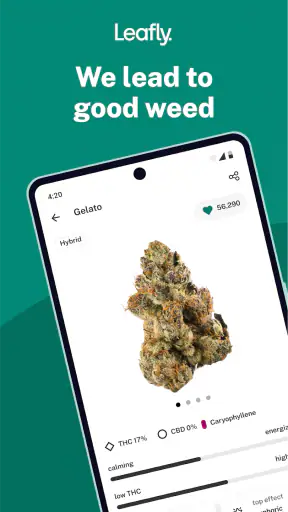
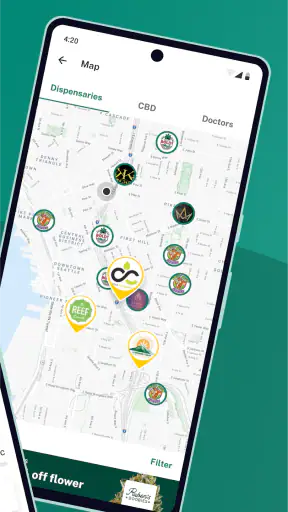

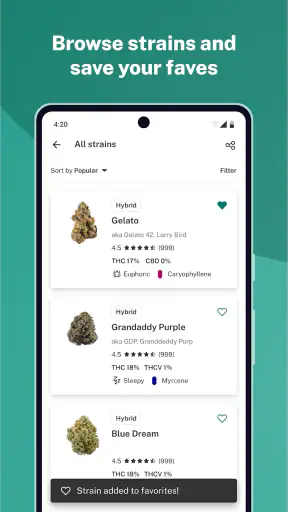
I approached Leafly: Find Cannabis and CBD as a practical reference app rather than something to open casually and browse forever. Its main value is bringing dispensary discovery, cannabis strain information, and CBD-related guidance into one mobile experience. That makes it useful when I want to compare options before leaving home, understand what a product category means, or narrow a search without relying on scattered web pages.
Leafly Holdings, Inc developed this free medical-category app for adults, and its mature 17+ rating is an important part of the context. Cannabis information needs to be handled responsibly, and I would treat the app as an educational and discovery tool, not as a substitute for a doctor, pharmacist, or local legal guidance. The app is available for Android and iOS, with a current version of 9.1.0 and support beginning at OS 7.1.
What stood out to me most was the way the app connects information with a real-world decision. A strain page can help me learn about a name I have heard, while dispensary discovery can help turn that research into a visit. That combination is more useful than a simple directory or a basic encyclopedia on its own. Still, the experience depends heavily on how current local listings and product information are, so I would always use the app as a starting point and confirm important details with the dispensary.
How Leafly feels during normal browsing and searching
Quick enough for short, purposeful sessions
In everyday use, Leafly makes the most sense when I already know what I want to investigate. Searching for a strain, looking through nearby dispensaries, or checking cannabis and CBD information is naturally suited to brief sessions. I can open the app with a question in mind, gather enough context to make a better choice, and leave without needing to spend a long time learning the interface.
The perceived speed is also tied to the kind of content being opened. A simple information page should feel more immediate than a location-based search that has to present nearby options. I would not judge the app only by how quickly its first screen appears, because the more useful moments involve moving between discovery, product context, and local availability. In that workflow, a little patience is reasonable, particularly when I am asking the app to narrow results around a location.
One practical habit improves the experience: I decide my purpose before searching. If I am trying to learn about a strain, I stay in the strain information area instead of repeatedly switching between unrelated searches. If I am planning a purchase, I begin with dispensaries and then use the available information to compare possibilities. This avoids turning a focused task into endless scrolling.
Where browsing can become slower in practice
The app is less efficient when I treat it like a general social feed. Cannabis names can lead to many similar results, and broad browsing can create decision fatigue. The problem is not necessarily technical slowness; it is that the amount of information can make the next step less obvious. I found it better to use a few clear filters or search terms than to open every appealing result.
Location-based discovery can also require more attention than a static list. A nearby dispensary may be convenient, but convenience alone does not answer whether its current selection, hours, ordering process, or local requirements suit my situation. Leafly helps me begin that comparison, while the final check still belongs with the business itself. That distinction saves time because it prevents me from assuming that an app page automatically represents the latest real-world conditions.
Useful speed tips for first-time users
Start with one goal: education, strain research, CBD exploration, or dispensary discovery.
Use a specific search term when possible instead of browsing every category at once.
Before traveling, check the selected dispensary’s current details directly rather than relying on an old saved impression.
Read the information around a strain instead of choosing from its name alone; names can be familiar without telling me whether the option fits my needs.
These habits make Leafly feel faster because they reduce unnecessary navigation. They also make the results more meaningful. The app is strongest when it helps me answer a defined question, not when I expect it to make every decision for me.
What happens during heavier use
The most demanding sessions are likely to be the ones where I combine local discovery with extensive reading. For example, I might compare several dispensaries, open multiple strain pages, return to search results, and then revisit an educational section to clarify terminology. That kind of session asks more from both the app and the device than checking one page.
My advice is to separate research into stages. First, identify the type of information I need. Next, shortlist a small number of possibilities. Finally, verify the practical details before acting. This workflow is not just easier on the phone; it also reduces the chance that I confuse educational information with a current product offer.
Leafly is particularly useful for someone who wants to become more informed before speaking with a dispensary employee. I can arrive with better questions instead of asking for a recommendation without knowing what I am looking for. That is a subtle but valuable benefit: the app can improve the quality of the conversation, even when it does not provide the final answer.
Stability and trust in the information flow
A stable experience is more than avoiding crashes. For this kind of app, reliability also means being able to move from a general explanation to a local result without losing the purpose of the search. Leafly’s combined focus on dispensaries, strains, cannabis, and CBD gives that journey a logical shape. I can begin with education and move toward planning, or start with a local search and then investigate unfamiliar terms.
There is an important limitation, however. Local business information changes faster than general educational content. A dispensary’s availability, operating details, or product selection can shift after I have viewed a page. I would therefore use Leafly to make a shortlist, then confirm anything time-sensitive before making a trip. This is not a reason to dismiss the app; it is the correct way to use a discovery service.
The same caution applies to strain information. Descriptions can help me understand how products are categorized and discussed, but personal responses vary. I would not treat a strain profile as a guarantee of a particular experience. People with medical questions, medication concerns, or health conditions should speak with a qualified professional rather than relying on app content alone.
How the app compares with ordinary alternatives
The usual alternative is a web search followed by separate visits to dispensary websites, product pages, and general cannabis education resources. That approach can work, but it often leaves me assembling the context myself. Leafly’s advantage is the connection between those tasks. I can investigate a strain and then look for places where cannabis products may be available without starting from zero each time.
A dispensary’s own website may be better for the final transaction details because it represents that specific business. A medical professional is better for personal health advice. A general search engine may be better when I need information outside Leafly’s focus. In my view, Leafly sits between these options: more organized than a loose web search, broader than one retailer, but not authoritative enough to replace professional or direct business confirmation.
That middle position is exactly why I would recommend it to a curious adult who wants a structured first step. It is less suitable for someone who wants only one dispensary’s live menu, or for someone seeking individualized medical guidance. Knowing that boundary prevents disappointment.
Device limits, storage expectations, and recovery
Because the app supports OS 7.1 and later, it is not restricted to only the newest phones and tablets. That broad compatibility is helpful for people using an older supported device, although compatibility does not guarantee the same smoothness on every model. A newer phone will generally be more comfortable for extended browsing, especially when I am switching between location discovery and detailed information pages.
I would also avoid judging resource use from a single short visit. A quick search is a lighter task than a long session involving many pages and location-based results. If the app feels less responsive after extended use, my first practical step would be to close it and reopen it, then check whether the device itself is under pressure from other apps. That is ordinary maintenance, but it matters when an information app is being used as a planning tool.
Recovery is important because users may open Leafly while already on the move. If I lose my place during a search, I can usually recover more easily by returning to the original goal rather than trying to reconstruct every page I viewed. I would note the dispensary or strain I am comparing before opening several alternatives. This small habit makes the app more dependable in real use, even when the phone or connection is not ideal.
Who will get the most from it
Leafly is a strong fit for an adult who wants a clearer starting point before visiting a dispensary. It is also useful for someone who encounters unfamiliar strain names and wants plain-language context, or for a person exploring CBD information alongside broader cannabis topics. The app is especially practical when I am comparing several local possibilities and do not want to search each one separately.
A realistic example would be planning an evening errand in an unfamiliar area. I could use Leafly to identify nearby dispensaries, review the information connected with products or strains that interest me, and create a short list. Before leaving, I would confirm the location’s current details directly. At the counter, I could ask more specific questions because I had already learned the basic vocabulary and differences that mattered to me.
It is less appropriate for a minor, someone looking for recreational entertainment rather than responsible information, or anyone expecting a diagnosis or personalized treatment plan. I would also skip it as my only source if I needed guaranteed real-time inventory or a definitive answer about how cannabis interacts with a prescription. Those situations call for direct, qualified sources.
My final performance verdict
After using Leafly as a research and discovery companion, I see its performance in practical terms: it is most effective when I keep searches focused, limit unnecessary browsing, and verify time-sensitive local details. It brings several related tasks together without pretending that an app can settle every medical or purchasing question.
The app has earned a 4.7 average from around 95 thousand ratings, with about 17 thousand written reviews and over 5 million installs. Those figures suggest a well-established audience, but they do not remove the need for personal judgment. The free price makes it easy to try, while the mature age rating clearly signals that it is intended for adults.
My recommendation is straightforward: use Leafly to learn, compare, and prepare better questions. Do not use it as a replacement for a healthcare professional, a dispensary’s direct confirmation, or local rules. For a focused cannabis and CBD reference experience with local discovery built in, it is a useful choice. Its main trade-off is that the more I ask it to do at once, the more carefully I need to manage the search and verify the result.
Leafly was released on January 24, 2012, and its continued presence is reflected in the current 9.1.0 version. I would install it if I wanted one place to begin researching strains and dispensaries, especially before visiting somewhere unfamiliar. I would keep my expectations realistic, use it deliberately, and treat its information as a helpful guide rather than the final word.


